Outdated FEMA Flood Maps: How Drone LiDAR Protects Cities
March 18, 2026
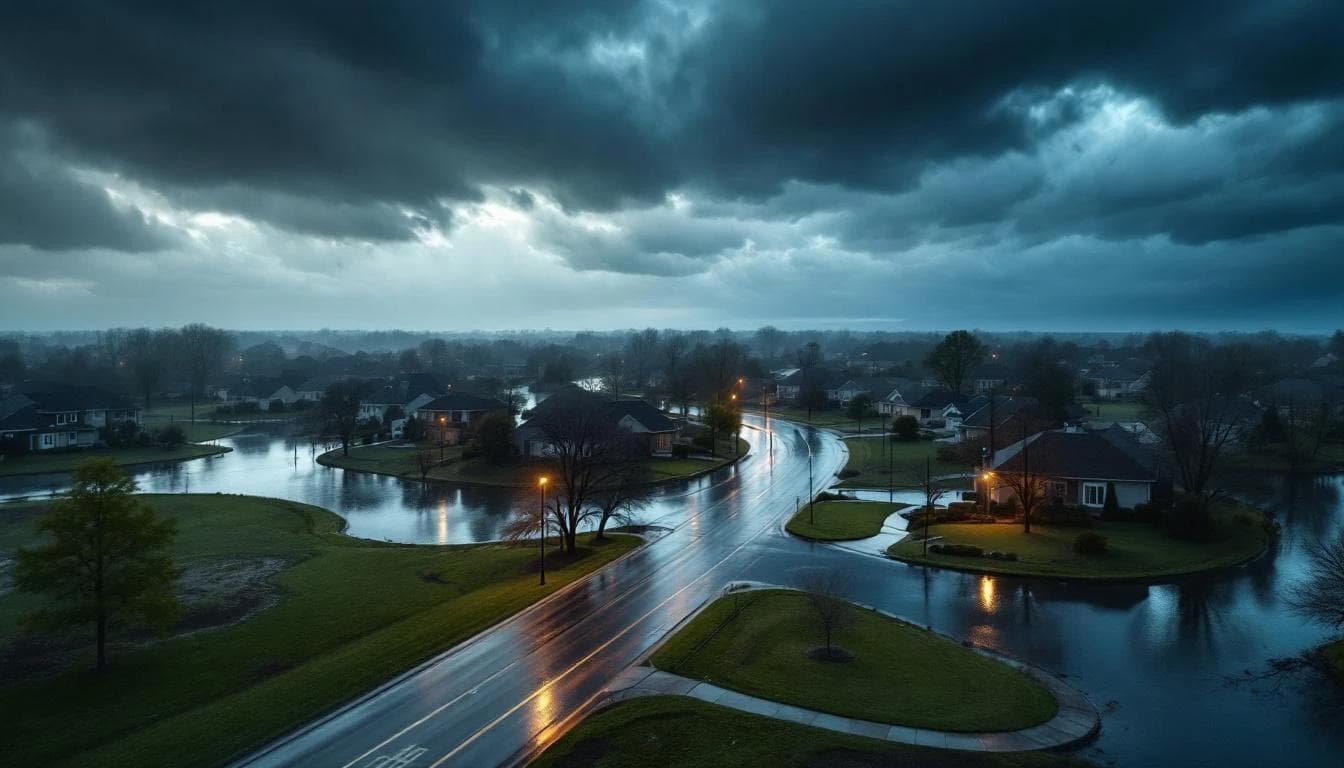
Here's a fact that surprises a lot of city engineers when they hear it: more than half of FEMA's flood insurance rate maps are out of date. A Department of Homeland Security Inspector General review put the figure at 58%, and the NRDC's analysis notes that almost two-thirds of FEMA's maps haven't been updated in the last five years — with many communities relying on maps last revised in the 1980s. Areas that flooded during Hurricane Sandy in 2012 were running on maps from 1983.
That's a problem because the maps drive everything downstream: flood zone designations, insurance requirements, building permits, capital improvement priorities, and grant scoring. And underneath every map is a digital elevation model that's only as good as the terrain data it was built from.
For municipalities — especially in Southern California, where development pressure, drought-flood cycles, and aging stormwater infrastructure all collide — high-resolution drone LiDAR has become the most practical way to close the terrain-data gap and modernize flood planning.
Why terrain accuracy is the whole game
Flood mapping is a chain. Precipitation estimates feed hydrologic models. Hydrologic models feed hydraulic models (typically HEC-RAS for FEMA studies). Hydraulic models deliver inundation depths and floodplain boundaries. Every link in that chain sits on top of one input: the bare-earth digital elevation model that describes the ground.
Get the terrain wrong by half a foot, and a flat coastal plain or valley floor can put dozens of properties on the wrong side of the flood line. Get it right, and engineers can actually quantify how a 25-year storm moves across the landscape.
What FEMA's current standard actually requires
FEMA modernized its expectations in the Risk MAP Elevation Guidance (November 2022). For new floodplain mapping work, FEMA has standardized on USGS 3DEP Quality Level 2 (QL2) LiDAR as the minimum acceptable input.
QL2 is a specific, measurable thing — not a marketing label. Per USGS's 3DEP Topographic Data Quality Levels documentation, QL2 requires:
- 10 cm root-mean-square error in the vertical (RMSEz) for non-vegetated terrain
- 2 points per square meter minimum point density
- Testing against the ASPRS Positional Accuracy Standards (Edition 2, 2024) using both Non-Vegetated Vertical Accuracy (NVA) and Vegetated Vertical Accuracy (VVA)
QL1 — twice the density and roughly twice the precision — is the newer specification baseline being phased in for applications that need finer resolution, such as dense urban drainage analysis or coastal subsidence monitoring.
The catch: FEMA's standard applies to newly produced maps. The map you can pull from the Flood Map Service Center today for any given community is often built on terrain inputs that pre-date the QL2 standard — sometimes by decades. The National Flood Hazard Layer carries those legacy data sources forward into the regulatory product.
Where the impact actually shows up
The most striking number isn't about map vintage — it's about claims. More than 25% of NFIP claims and roughly one-third of federal flood disaster assistance go to properties outside the mapped high-risk floodplain. Twenty percent of historical NFIP claims come from policyholders in X, B, or C zones — areas the maps designate as low or moderate risk.
When that many losses occur outside the regulatory floodplain, the underlying terrain model isn't capturing where water actually goes. That's the gap drone LiDAR is filling at the municipal scale.
Precipitation has also moved
Terrain isn't the only stale input. NOAA Atlas 14 — the Precipitation Frequency Data Server maintained by NOAA's Office of Water Prediction — is the federal authority for design-storm precipitation estimates. It has been published in regional volumes over the last twenty years, and current Atlas 14 values often differ materially from the older HYDRO-35 and TP-40 estimates that many legacy drainage designs were sized against.
A drainage system designed in 1985 against TP-40 estimates may now be undersized against the current Atlas 14 25-year storm for the same location, independent of any other change. Pairing the updated precipitation data with a current bare-earth DEM is the only way to know what a system can actually handle today.
The state of municipal stormwater
The ASCE 2025 Infrastructure Report Card gave overall U.S. infrastructure its highest grade ever — a C. Stormwater infrastructure, scored as its own category since 2021, received a D. It has not improved in this most recent cycle.
That's the operating environment most public-works directors are managing: aging pipes, undocumented capacity, rising precipitation design values, and flood maps that increasingly contradict observed events. Better terrain data is one of the few inputs a municipality can actually upgrade quickly.
What cities are doing about it

Stormwater master planning
Replacing the legacy DEM in a system-wide stormwater model with current QL2-or-better LiDAR routinely changes which segments of the system show capacity problems. Capital-improvement priority lists get reshuffled based on present risk instead of decades-old contours.
Pre-construction drainage review
When a planning department has high-resolution terrain for the area around a proposed development, engineers can model how the new impervious surface and grading will affect neighbors before the permit is signed, not after the complaints come in.
Infrastructure capacity assessment
Pairing accurate terrain with as-built storm sewer records lets engineers evaluate whether existing pipes and culverts have adequate capacity for the current Atlas 14 design storm, given the actual impervious cover today — not the impervious cover assumed during the original design.
Grant scoring
FEMA's Building Resilient Infrastructure and Communities (BRIC) program is back online as of March 2026 following a court-ordered reinstatement. The current application cycle makes $1 billion in funding available, with submissions open through July 23, 2026. BRIC explicitly supports hazard mitigation projects, and the Hazard Mitigation Grant Program (HMGP) covers planning-related activities and project scoping. Both programs score applications more favorably when risk analysis is backed by quantitative, current terrain data than when it's narrative-only.
A practical, phased approach
Nobody expects a city to LiDAR-scan its entire jurisdiction in year one. The pattern that works for SoCal communities we've talked to is phased:
Phase 1 — known flood zones and active CIP areas
Start with the neighborhoods that have a complaint history and the corridors where capital improvements are already in design. Scanning 1–5 square miles of high-priority area gives immediate value to work already underway.
Phase 2 — development-pressure zones
Target the parts of the jurisdiction where grading and impervious surface are changing fastest. In the western Inland Empire, for example, new construction is outpacing drainage infrastructure in several sub-basins. Proactive scanning here prevents the build-flood-complain-redesign cycle.
Phase 3 — full-jurisdiction coverage
A city-wide DEM that supports long-range stormwater planning and regulatory updates. Each phase stands on its own; terrain in developed areas changes slowly, so a scan stays valid for years.
What to ask for in the deliverable set
A defensible municipal LiDAR deliverable set should include, at minimum:
- A classified point cloud in the ASPRS LAS/LAZ format, with returns classified per the USGS Lidar Base Specification (ground, vegetation, building, water, noise)
- A hydro-flattened bare-earth DEM, at native resolution
- Contour lines at one-foot or half-foot intervals in DXF or Shapefile, for CAD/GIS engineering use
- Hydrologic flow products (flow direction, flow accumulation, watershed delineation) suitable for input to stormwater models
- A formal accuracy report against the ASPRS Edition 2 standard, with NVA/VVA values and the survey-grade checkpoint coordinates used

For projects that will feed FEMA submittals (LOMR or CLOMR work), conformance with FEMA's elevation specification matters more than the marketing accuracy figure. Get the spec compliance documented in the deliverable from the start.
What this honestly costs
Drone LiDAR for municipal work typically runs in the low thousands of dollars per square mile in our Southern California experience, with the spread driven by vegetation density, ground-control requirements, and how strict the deliverable specification is. We publish general pricing in our 2026 drone survey cost guide — exact quotes depend on the site.
The economics are easier to defend internally when paired with an existing capital project. Adding a LiDAR survey to a drainage-improvement scope is typically a marginal cost increase that improves design quality and cuts construction-phase rework risk. For a free-standing data acquisition, the framing that works in budget meetings is avoided cost: what does one flood damage claim cost the city, versus the data needed to redesign the system that produced the claim?
Where this is going
FEMA's adoption of QL2 as the minimum for new mapping work is one signal of where the bar is moving. USGS's 3DEP program continues to add coverage and tighten specifications — the goal is full national coverage at QL2 or better. Insurance carriers are increasingly evaluating LiDAR-grade terrain for risk pricing. And the ASCE 2025 stormwater grade of D is unlikely to budge without better data driving smarter capital investments.
Cities investing in current high-resolution terrain now are building the foundation that regulatory and funding requirements are converging toward anyway. The question isn't whether the bar will be QL2-or-better — it's whether your jurisdiction will be ready when it is.
Sources cited in this article
Every quantitative claim above links directly to its source. The full set of references for further reading:
- USGS — Topographic Data Quality Levels (QL definitions and accuracy)
- USGS — Lidar Base Specification (full technical spec for 3DEP collections)
- USGS — 3D Elevation Program and Flood Risk Management (Fact Sheet 2017-3081)
- FEMA — Risk MAP Elevation Guidance (November 2022)
- FEMA — National Flood Hazard Layer
- FEMA — Flood Map Service Center
- FEMA — Building Resilient Infrastructure and Communities (BRIC)
- FEMA — Hazard Mitigation Grant Program (HMGP)
- ASPRS — Positional Accuracy Standards for Digital Geospatial Data (Edition 2, 2024)
- NOAA — Atlas 14 Precipitation Frequency Data Server
- ASCE — 2025 Infrastructure Report Card: Stormwater
- NRDC — Accurate Flood Maps Are Essential for Climate Adaptation
- U.S. Army Corps of Engineers — HEC-RAS Hydraulic Modeling