What to Expect When You Hire a Drone Surveyor: A Buyer's Guide
March 26, 2026
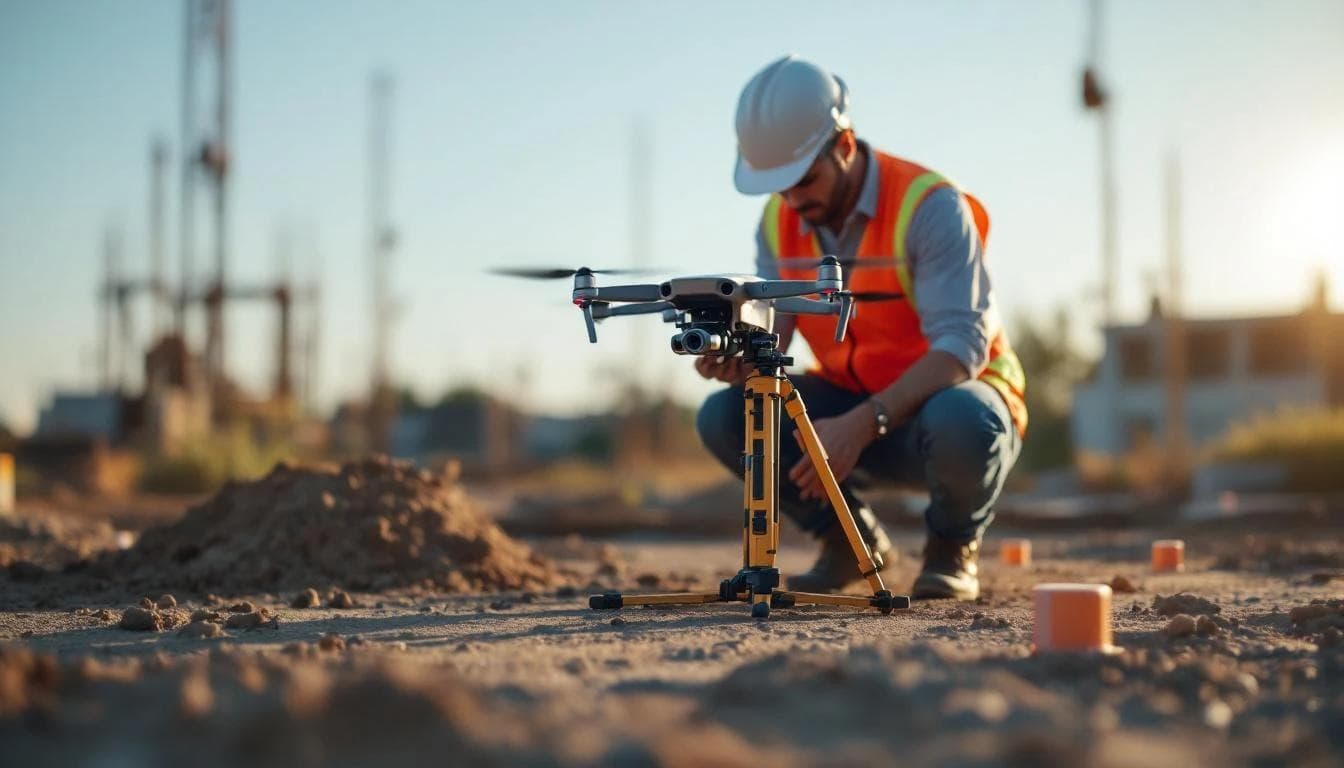
If you've never contracted a drone survey before, the process can feel opaque — what gets asked, what gets delivered, what the timeline looks like, and where the price comes from. This walks through the actual workflow from initial inquiry through final delivery, with the technical and regulatory framework that should shape what you're being told at each step.
Step 1: The inquiry and site scoping
A good first conversation should cover four things, in roughly this order:
What's the project, and what's the deliverable?
Are you producing a topographic base map for civil design? A volume calculation for a stockpile audit? A bare-earth DEM for hydrologic modeling? A 3D site documentation for BIM coordination? Each drives a different flight plan, processing pipeline, and deliverable spec. A provider who jumps straight to a price without understanding the use case is going to under-spec or over-spec the work.
What's the site, and is it flyable?
Location matters for airspace, vegetation, terrain relief, and access. In Southern California, much of the urbanized area sits under controlled airspace — Class B around LAX and SAN, Class C/D around regional airports — requiring authorization via the FAA's LAANC system. Off-airport sites are typically straightforward; near-airport or near-restricted airspace requires advance coordination.
What CRS, datum, and deliverable format do you need?
This question separates surveyors from drone operators. The right deliverable for a Civil 3D workflow looks different from the right deliverable for an ArcGIS hydrology workflow. Standard answers reference an authoritative datum from NOAA NGS (NAD83(2011) horizontal, NAVD88 with GEOID18 vertical for most of CONUS) and ASPRS-standard file formats.
What's the accuracy class required?
This anchors the entire scope. ASPRS Positional Accuracy Standards Edition 2 (2024) defines vertical accuracy classes by RMSEz value. The right class depends on what the data is for — see our deep-dive on what sub-2cm really means for the trade-offs.
Step 2: The quote
A defensible quote should specify, in writing:
- Project area and the flight planning approach
- Sensor and platform (e.g., DJI Zenmuse L2 on Matrice 350 RTK)
- Target point density and ASPRS accuracy class
- Number and type of checkpoints for accuracy verification (current ASPRS minimum: 30)
- Horizontal and vertical datum + geoid model
- Deliverable file formats — ASPRS LAS/LAZ for the cloud, GeoTIFF for rasters, DXF or LandXML for CAD, etc.
- Turnaround time
- Insurance coverage and additional-insured certificate
- Acceptance criteria and revision policy
If the quote is just a line item and a price, ask for the technical scope. Vague quotes correlate with vague deliverables. For typical price ranges, see our 2026 cost guide.
Step 3: Pre-flight planning
Before the drone leaves the ground, the provider should be doing several things you might not see directly:
Airspace authorization
For controlled airspace, LAANC authorization is filed in advance — often near-real-time for class B/C/D up to certain altitudes. For airspace outside LAANC coverage or above the LAANC ceiling, a formal FAA authorization or blanket COA may be required. Either way, the paperwork should exist before flight.
Flight plan
Flight altitude, ground speed, sidelap, and number of strips are calculated to hit the target point density and accuracy class. For LiDAR work, typical SoCal flight altitude is 60–100 m AGL — lower for higher density, higher for broader coverage. FAA Part 107 caps altitude at 400 ft AGL without a specific waiver, which is the operational ceiling for most commercial drone work.
Ground control planning
Where will the survey checkpoints go, and how will they be coordinated? For the most rigorous work, checkpoint coordinates are tied to the NGS-managed CORS network via RTK rover or local published control monuments.

Step 4: The flight day
The on-site work is usually faster than people expect. A typical 50-acre site:
- Setup, base station deployment, and final airspace check: 30–60 minutes
- Checkpoint survey (~10–30 points): 1–2 hours, often by a separate crew member during the flight
- Drone flight: 20–60 minutes per battery, multiple swaps for larger sites
- Field QC of raw data: 15 minutes after each flight to confirm complete coverage
Conditions that affect flight day: wind (sustained > 25 mph stresses platform stability and accuracy), precipitation (most enterprise drones are weather-tolerant but heavy rain degrades LiDAR returns), and visibility. Reschedules happen — that's normal, not a red flag.
Step 5: Processing
What happens between the flight and your delivery is where the deliverable quality is determined.
Trajectory + georeferencing
PPK (Post-Processed Kinematic) processing combines the raw GNSS data from the drone and base station to compute the precise flight trajectory. Modern systems like the DJI Zenmuse L2 achieve 1 cm + 1 ppm horizontal and 1.5 cm + 1 ppm vertical positioning accuracy in PPK.
Point cloud generation and classification
For LiDAR, the trajectory plus laser returns produces the raw point cloud. Classification then assigns each return a category (ground, vegetation tiers, buildings, water, noise) per the USGS Lidar Base Specification scheme. Automated classification handles most of the work; manual review is where quality is made or lost on complex sites.
Bare-earth DEM and derivatives
Ground-classified points feed a continuous bare-earth surface, typically hydro-flattened for downstream hydrology use. Contours, slope/aspect rasters, and orthomosaics are derived from there.
Accuracy verification
Independent checkpoints (held out from processing) are compared against the LiDAR surface to produce the formal accuracy report — RMSEz, mean error, standard deviation, NVA and VVA values, ASPRS accuracy class achieved.
Step 6: Delivery
What should you actually receive at the end? At minimum:
- Classified point cloud in ASPRS LAS or LAZ format
- Bare-earth DEM (hydro-flattened if specified) as GeoTIFF or equivalent raster
- Contour lines at the agreed interval in DXF or Shapefile
- Orthomosaic (if the project includes photogrammetric capture) at the specified GSD
- An accuracy report against ASPRS Edition 2 — listing every checkpoint, the LiDAR elevation at that point, the surveyed elevation, the residual, and summary statistics
- Metadata: project area, datum, CRS, sensor used, processing software and versions, dates of acquisition and processing
If you're producing a deliverable for a regulated submittal — FEMA LOMR/CLOMR, FAA obstruction analysis, an MS4 permit report — there are additional format and conformance requirements. FEMA's Risk MAP Elevation Guidance (Nov 2022) is the canonical reference for floodplain mapping work.
Typical timelines
For a single-site project under 200 acres on accessible terrain, a reasonable end-to-end timeline:
- Quote to contract: 1–5 business days
- Pre-flight planning + airspace authorization: 2–7 business days

- Flight day: 1 day on site
- Processing + QA: 5–10 business days for most projects, longer for complex classification or unusual deliverable formats
- Total: ~2–3 weeks from contract to delivery for a typical project
Larger sites, complex deliverables, or projects feeding regulatory submittals can take longer. A provider that promises 48-hour turnaround on a 500-acre LiDAR project with FEMA-grade deliverables is either skipping QA or marking up to outsource it.
What you should ask along the way
See our companion post on 12 questions to ask a drone LiDAR provider — every one of those questions maps to a real standard or regulation, and the answers should reference them. The short version:
- Pilot certificate numbers, verifiable through FAA Airmen Inquiry
- Insurance certificate naming your organization as additional insured
- ASPRS Edition 2 accuracy class on the deliverable
- Minimum 30 checkpoints with independent survey of each
- Boresight calibration date and methodology
- CRS, datum, and geoid model that match your existing project files (NGS publishes the authoritative geoid models)
What changes for regulatory deliverables
If the project feeds a regulatory submittal, the requirements get stricter:
- For FEMA floodplain work: USGS 3DEP Quality Level 2 or better LiDAR is the minimum acceptable input. The deliverable needs to conform to FEMA's Risk MAP Elevation Guidance.
- For municipal MS4 work: deliverables typically feed an EPA NPDES-permitted Stormwater Management Program; hydraulic modeling typically uses USACE HEC-RAS.
- For airspace-adjacent work: pilots should hold current FAA Part 107 certification and aircraft must comply with Remote ID rules.
Sources cited in this article
- FAA — Part 107 Small UAS Rule
- FAA — LAANC Airspace Authorization
- FAA — Airmen Inquiry (verify pilot certificates)
- ASPRS — Positional Accuracy Standards Edition 2 (2024)
- ASPRS — LAS/LAZ file format
- USGS — Lidar Base Specification (classification scheme)
- NOAA NGS — CORS Network
- NOAA NGS — Datums and geoid models
- FEMA — Risk MAP Elevation Guidance (Nov 2022)
- DJI — Zenmuse L2 official specifications
- USACE Hydrologic Engineering Center — HEC-RAS